
Hydro jetting vs. snaking is the first decision every New Jersey homeowner faces when a drain backs up — and choosing the wrong method is the most common reason clogs come back within months. Snaking is faster and cheaper; hydro jetting is more thorough and lasts far longer. The right answer depends on what’s blocking your pipe, how old your plumbing is, and whether this is your first clog or your fourth. In this guide, the technicians at Valley Sewer & Drain in Fairfield explain exactly how each method works, what each costs in New Jersey, and how to know which one your home actually needs.
Key Takeaways
- Snaking ($150–$650) punches a hole through the clog — fast, affordable, best for simple single-fixture blockages
- Hydro jetting ($400–$950) scours the entire pipe wall clean — best for grease, roots, and recurring clogs
- Snaked lines often re-clog in months; jetted lines typically stay clear for years
- A camera inspection is the smart first step for old or fragile pipes
- Valley Sewer & Drain does both — and recommends only what your line needs: (973) 694-0024
What Is Drain Snaking?
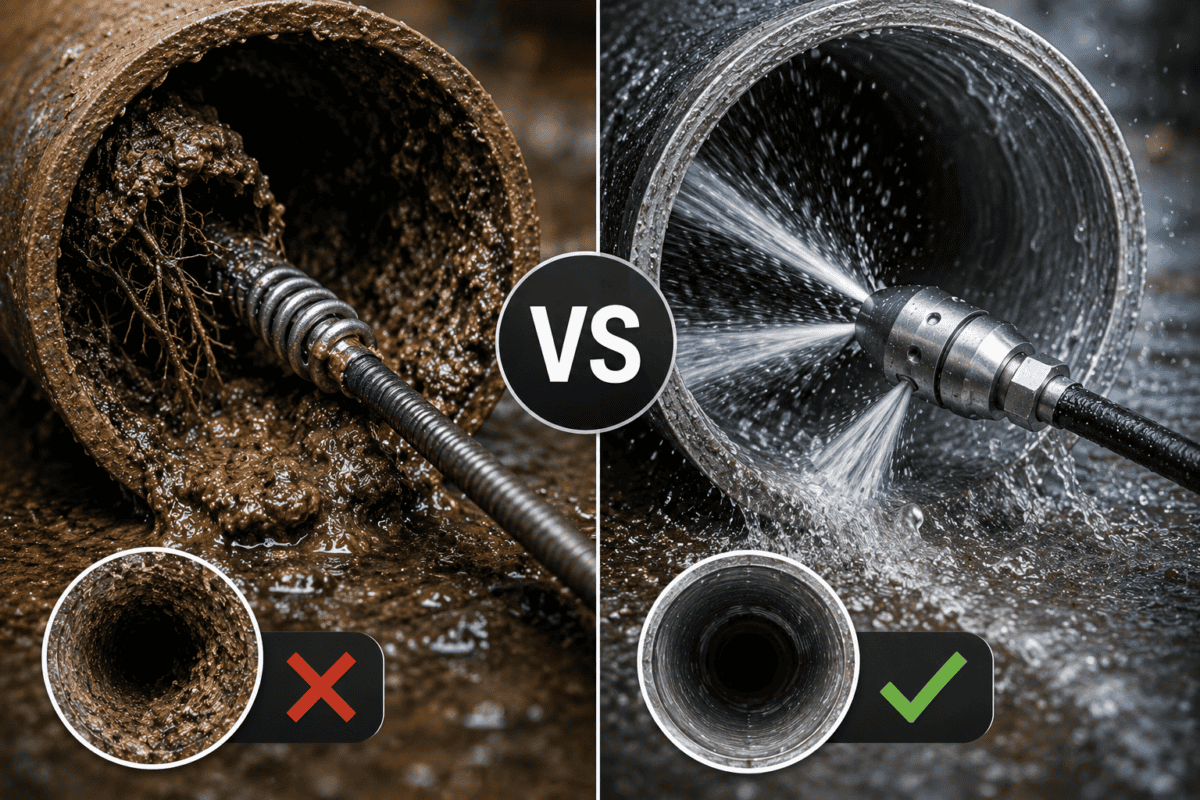
Drain snaking — also called augering, rodding, or cabling — uses a flexible steel cable fed into the pipe, with a cutting or corkscrew head on the end. As the cable rotates, the head chews through the blockage or hooks it so it can be pulled back out. Hand-held snakes handle sink and tub clogs near the fixture; motorized drum machines with 75–100 feet of heavy cable tackle main sewer lines.
Snaking has been the industry standard for decades because it works: for a wad of hair in a shower drain, a flushed object in a toilet line, or a single soft blockage, a snake clears the problem in under an hour at the lowest price point in professional drain cleaning.
The limitation: a snake bores a hole through the clog — it doesn’t remove what’s coating the pipe walls. Grease, sludge, scale, and root fragments stay behind, and the narrowed pipe starts catching debris again almost immediately. That’s why a snaked kitchen line in a busy household often backs up again within 6–12 months.
Snaking Pros and Cons
- Pros: Lowest cost, fast, works on nearly all pipes including older or fragile lines, ideal for object removal and simple clogs
- Cons: Leaves buildup on pipe walls, temporary fix for grease and roots, can scratch older pipes if used aggressively, doesn’t clean — it just clears
What Is Hydro Jetting?
Hydro jetting uses water pressurized up to 4,000 PSI, delivered through a hose with a multi-directional nozzle. Forward-facing jets cut through the blockage while rear-facing jets blast the pipe walls clean and propel the hose deeper into the line. Instead of drilling a hole through the clog, jetting strips the entire pipe interior back to bare pipe — grease, soap scale, sludge, sediment, and even intruding roots are cut away and flushed downstream to the municipal main.
Think of it this way: snaking is poking a hole through a clogged artery; hydro jetting is cleaning the artery walls. That difference is why jetted lines stay clear for years rather than months, and why jetting is the standard maintenance method for restaurants and commercial kitchens across North Jersey.
Hydro Jetting Pros and Cons
- Pros: Removes 100% of buildup including grease and roots, longest-lasting result, cleans the full pipe diameter, sanitizes the line, no chemicals
- Cons: Higher upfront cost, requires a camera inspection first on old or damaged pipes, overkill for a simple one-time hair clog
Hydro Jetting vs. Snaking: Side-by-Side Comparison
| Factor | Snaking | Hydro Jetting |
|---|---|---|
| Typical NJ cost | $150 – $650 | $400 – $950 |
| How it works | Steel cable bores through the clog | High-pressure water scours pipe walls |
| Best for | Hair, objects, simple soft clogs | Grease, sludge, scale, roots, recurring clogs |
| How long it lasts | Months to a year | Several years with normal use |
| Cleans pipe walls? | No | Yes — full diameter |
| Safe for fragile pipes? | Yes, with care | After camera inspection confirms condition |
| Typical job time | 30 – 60 minutes | 1 – 2 hours |
When Snaking Is the Right Choice
- It’s your first clog in years. A one-off blockage from hair or a dropped object doesn’t need the full treatment.
- The clog is at a single fixture. One slow sink or tub, while everything else drains fine, points to a local blockage a snake handles easily.
- Something was flushed or dropped. A snake can hook and retrieve objects; a jet would just blast water around them.
- Budget is the priority today. Snaking gets you flowing again at the lowest cost — see our full NJ drain cleaning price guide for exact ranges.
When Hydro Jetting Is the Right Choice
- The same drain keeps clogging. If you’ve snaked a line two or three times in as many years, the pipe walls are coated. Jetting resets the pipe to like-new capacity and ends the cycle.
- Grease is involved. Kitchen lines in busy households — and every commercial kitchen — accumulate grease that snakes simply drill through. Jetting emulsifies and removes it.
- Tree roots have entered the line. Fine root intrusion in older laterals is shaved off by jetting nozzles. (Heavy root masses may need cutting heads first, and badly root-damaged pipe may ultimately need excavation and repair — a camera tells us which.)
- You’re maintaining, not reacting. Preventive jetting every couple of years keeps main lines clear before backups happen — the same logic municipalities use to prevent sanitary sewer overflows, which the U.S. EPA attributes largely to grease and root blockages in aging lines.
- You run a restaurant or commercial building. Scheduled jetting is the industry standard for code compliance and avoiding shutdown-level backups.
Is Hydro Jetting Safe for Older New Jersey Pipes?
This is the most common question we hear in towns like Boonton, Wharton, and Montville, where plenty of homes still drain through original clay or cast iron laterals. The honest answer: jetting is safe for structurally sound pipes of any age, but pressure must be matched to pipe condition — which is why a professional runs a sewer camera inspection first whenever age or condition is in question. If the camera reveals cracks, offset joints, or a collapsing section, we’ll tell you before any water is fired — because jetting a broken pipe wastes your money, and the real fix is a repair. That inspect-first approach is standard practice at Valley on every older line.
Which Method Is More Cost-Effective Over Time?
Run the math on a recurring kitchen-line clog: three snakings at $300 each over four years is $900 — and you lived with three backups. One hydro jetting at $600 typically keeps that same line clear for the full stretch, with zero backups. For one-time clogs, snaking wins on price. For any line with a history, jetting is almost always the cheaper method per year of clear flow. The NJ Department of Environmental Protection points to fats, oils, and grease as a leading cause of line blockages statewide — and grease is precisely the problem snaking can’t solve.
What About Chemical Drain Cleaners?
Skip them. Caustic drain chemicals generate heat that softens PVC joints, corrodes older metal pipes, and rarely removes the full blockage — the clog returns, now in a pipe that’s been chemically damaged. Between the two professional methods in this guide, either one is safer and more effective than anything sold in a jug.
Serving All of North Jersey — Both Methods, One Honest Recommendation
Valley Sewer & Drain runs both cable machines and commercial-grade jetters on every truck, so the method we recommend is based on your pipe — not on what equipment we happen to have. We serve homeowners and businesses across Essex, Morris, and Passaic counties, including East Hanover, Randolph, Kinnelon, and Florham Park — see the full list on our areas served page.
Frequently Asked Questions
Is hydro jetting better than snaking?
For grease, roots, and recurring clogs, yes — hydro jetting removes the buildup snaking leaves behind, so results last years instead of months. For a simple first-time clog or retrieving a flushed object, snaking is the better and cheaper tool.
How much more does hydro jetting cost than snaking in NJ?
In New Jersey, snaking typically runs $150–$650 and hydro jetting $400–$950. Jetting costs roughly 50–100% more up front but usually lasts several times longer between cleanings.
Can hydro jetting damage old pipes?
Not when it’s done right. A camera inspection first confirms the pipe is structurally sound, and pressure is adjusted to the pipe material and condition. Jetting is routinely performed on sound clay and cast iron lines throughout North Jersey.
How long does hydro jetting keep a drain clear?
A residential line with normal use typically stays clear for 3–5 years after jetting. Lines with heavy grease loads or nearby tree roots benefit from jetting every 1–2 years as maintenance.
Will a snake get rid of tree roots?
A snake with a cutting head can chop through roots enough to restore flow, but roots regrow from the fragments left behind — often within a season. Jetting shaves roots flush with the pipe wall, and a camera inspection shows whether the intrusion point needs a permanent repair.
Do you recommend jetting or snaking for my home?
It depends on what the clog is made of and your line’s history — which is exactly what we determine on-site before quoting. Estimates are always free.
Not Sure Which Method You Need? Ask Us — It’s Free
Tell us what your drains are doing, and we’ll tell you honestly whether a $200 snaking or a full jetting is the right call. Call Valley Sewer & Drain at (973) 694-0024 or request a free estimate online. Same-day appointments, 24-hour emergency service, and a clog-free guarantee on every job.