
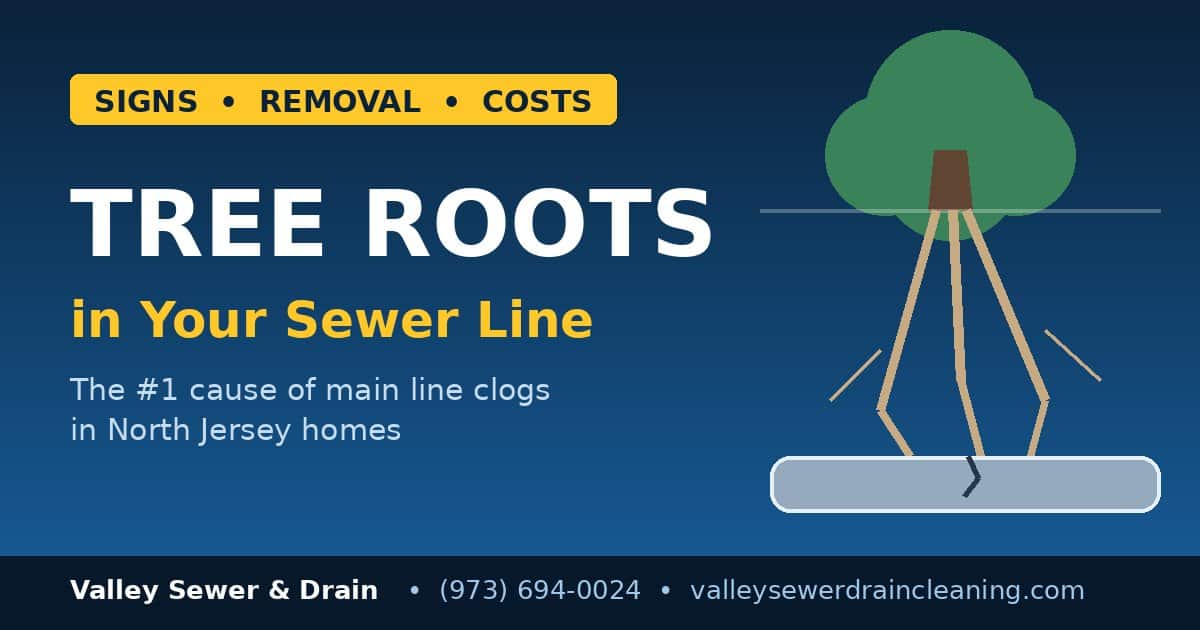
Tree roots in your sewer line are the single most common cause of main-line clogs and sewer damage in North Jersey — and if your home was built before the 1980s and has mature trees anywhere near the front yard, there’s a real chance roots are already inside your pipe. The good news: caught early, root intrusion is a manageable maintenance issue. Left alone, it ends in sewage backups and, eventually, a crushed pipe. In this guide, the technicians at Valley Sewer & Drain in Fairfield explain how roots get in, the warning signs to watch for, every removal option with real New Jersey costs, and how to keep them from coming back.
Key Takeaways
- Roots enter through tiny gaps at pipe joints — especially in the clay pipes under most pre-1980 NJ homes
- The classic symptom: a main line that clogs again every 6–12 months
- Removal costs in NJ: root cutting $275–$650, hydro jetting $400–$950; a camera inspection confirms what you’re dealing with
- Cutting removes roots; only a pipe repair removes the way in
- Free estimates from Valley Sewer & Drain: (973) 694-0024
Why Tree Roots Invade Sewer Lines
Your sewer lateral is the most attractive water source in your yard. It’s warm, it’s full of moisture and nutrients, and in older homes it’s made of vitrified clay laid in short sections with a joint every few feet. As soil shifts and gaskets age, those joints open hairline gaps — and tree roots, which sense moisture vapor escaping from the pipe, grow straight toward them. A root fine as a hair slips through the gap, finds the richest feeding ground it will ever encounter, and thickens. Within a couple of seasons, that single root becomes a mass of them, catching everything that flows past — grease, paper, wipes — until the line chokes.
This is why root intrusion is so widespread in leafy, older towns across Morris and Essex County. The housing stock and the street trees grew up together: a 1950s colonial in Butler, Riverdale, or Jefferson now sits behind 70-year-old maples whose root systems reach far past the drip line — easily to the sewer lateral and beyond. Blocked laterals aren’t just a private headache either: root blockages are one of the leading causes of the sewage overflows that the U.S. EPA tracks nationwide.
Signs You Have Tree Roots in Your Sewer Line
- The same line keeps clogging. The signature symptom. Roots regrow from whatever fragments a snake leaves behind, so a line that backs up every 6–12 months on schedule is almost always a root line.
- Gurgling toilets and slow drains house-wide. Roots narrow the main line gradually — the early symptoms are identical to any developing main-line clog. (Full list in our guide to the 7 warning signs of a clogged main sewer line.)
- Toilet paper hangs up but water passes. Root masses act like a net: liquid seeps through while solids and paper snag. Backups that start with “the toilet flushes weak” often end at roots.
- A lush green stripe or soggy patch in the yard. Roots that broke in are often feeding on sewage leaking out. Grass over the lateral that’s greener, taller, or wetter than the rest of the lawn is telling you where the pipe is compromised.
- Sinkholes or dips along the sewer path. Advanced root damage washes out soil around the pipe. A depression forming in a line between the house and street is a late-stage warning.
Step One: Confirm It With a Camera
Before spending a dollar on removal, find out what’s actually in the pipe. A sewer video inspection travels the lateral and shows the roots on screen: where they’re entering, how thick the mass is, and — critically — whether the pipe around the entry point is still sound or already cracked and shifting. That distinction decides everything, because it separates a $400 maintenance problem from a structural repair. You’ll see the footage yourself, so the recommendation is never a guess you have to take on faith.
Tree Root Removal Options (And What Each Costs in NJ)
Mechanical Root Cutting — $275–$650
A heavy-duty sewer machine with a root-cutting blade chews through the mass and restores flow. It’s the fastest, most affordable fix and the right first response to an active backup. The catch: cutting is a haircut, not a cure. Roots regrow from the stubs at the pipe wall, typically returning within 6–18 months. For many homeowners, an annual scheduled cutting is a perfectly reasonable way to manage a root-prone line.
Hydro Jetting With a Root Nozzle — $400–$950
Hydro jetting uses high-pressure water to shear roots flush with the pipe wall and flush out the debris — a cleaner, more complete removal than blades, and it strips the grease and sludge the roots were trapping at the same time. Jetted root lines generally stay clear noticeably longer than cut ones. Not sure which method fits your line? Our hydro jetting vs. snaking comparison breaks down exactly when each wins.
Chemical Root Treatments — $50–$200 (Maintenance Only)
Foaming root herbicides poured or applied into the line kill the fine roots they touch and slow regrowth between mechanical cleanings. Used correctly, they’re a legitimate maintenance layer — but they can’t dissolve an established root mass, they do nothing for the blockage you have today, and repeated heavy use of copper-based products raises environmental concerns. Think of chemicals as fertilizer-in-reverse between service visits, never as the fix itself.
Pipe Repair or Replacement — $2,000–$6,000 (Spot) / $8,000–$20,000+ (Full)
Roots got in because the pipe has an opening — and as they thicken, they act like a slow hydraulic jack, prying the joint wider every year until the pipe cracks or collapses. When the camera shows structural damage, excavation and repair of the damaged section permanently closes the door: modern PVC pipe with sealed joints gives roots nothing to enter. A spot repair replaces the compromised stretch; a full lateral replacement makes sense when the camera shows joint damage along the whole run. It’s the biggest ticket on this list, but it’s also the only option that ends the cycle for good.
How to Keep Roots From Coming Back
- Get on a schedule. If you’re keeping your original pipe, preventive cutting or jetting every 12–18 months costs far less than emergency backups. (See typical service prices in our NJ drain cleaning cost guide.)
- Plant smart. Keep new trees — especially thirsty, aggressive-rooted species like silver maple, willow, and poplar — well away from the sewer path. Rutgers NJ Agricultural Experiment Station publishes excellent guidance on choosing the right plants for residential landscapes.
- Know where your lateral runs. A camera locate maps the line so you can plan landscaping, fences, and driveways around it.
- Re-camera every few years. A root-prone line inspected periodically never gets to surprise you.
The Worst Trees for Sewer Lines in New Jersey
Any tree can find a leaking joint, but a few species are notorious sewer-seekers because of their fast growth and aggressively spreading, moisture-hunting roots: silver maple, willow, poplar and cottonwood, sweetgum, and American elm. All of them are common in established North Jersey neighborhoods, and their roots routinely travel two to three times the width of the canopy — meaning the beautiful maple across the street can be the one inside your lateral. Oaks and most evergreens are comparatively better-behaved, but no species is truly “sewer-safe” once a pipe joint starts leaking vapor into the soil. If one of the aggressive species stands within 30–50 feet of your sewer path and your line has never been camera-inspected, that inspection belongs near the top of your home maintenance list.
Frequently Asked Questions
How do I know if tree roots are in my sewer line?
The strongest clue is a main line that re-clogs on a schedule — every 6 to 12 months — along with gurgling drains and toilets that flush weakly. A sewer camera inspection confirms it visually and shows exactly where the roots are entering.
How much does tree root removal from a sewer line cost in NJ?
Mechanical root cutting runs $275–$650 and hydro jetting $400–$950 in New Jersey. If the pipe itself is damaged, spot repairs typically cost $2,000–$6,000 and full lateral replacement $8,000–$20,000+ depending on depth and length.
Will Drano or chemical cleaners kill roots in a sewer line?
No. Household drain chemicals have no effect on roots. Purpose-made foaming root herbicides can slow regrowth as maintenance between cleanings, but nothing in a bottle removes an established root mass.
Do roots mean my sewer pipe is broken?
Not necessarily — roots usually enter through small joint gaps in otherwise functional pipe. But their growth widens the opening over time, so a root line should be camera-inspected to check the pipe’s condition and re-checked periodically.
How fast do roots grow back after cutting?
Typically 6–18 months to a flow-affecting mass, faster for aggressive species like willow and silver maple. Jetting generally buys more time than blade cutting, and annual maintenance keeps regrowth from ever reaching backup stage.
Can I remove the tree to solve the problem?
Sometimes — but roots from neighboring trees can reach your lateral too, and a removed tree’s root system can keep growing for a while. Sealing the pipe (repair or replacement) is the only guaranteed fix; tree removal is a judgment call best made with the camera footage in hand.
Roots Don’t Negotiate — But We Do Free Estimates
If your main line keeps clogging or your yard is showing the signs, find out what’s really in the pipe before it decides for you. Call Valley Sewer & Drain at (973) 694-0024 or request a free estimate online. Camera inspections, root cutting, hydro jetting, and full repairs — same-day appointments and 24-hour emergency service across Essex, Morris, and Passaic counties. See our complete service area here.