
For a New Jersey restaurant, a drain backup isn’t an inconvenience — it’s a closed kitchen, a failed health inspection, and lost revenue by the hour. Commercial kitchens push more grease, food waste, and water through their drains in a day than a home does in months, and the lines, grease traps, and equipment that handle it need a maintenance program built for that load. This guide from Valley Sewer & Drain covers what commercial drain cleaning actually involves for NJ food businesses — grease trap service, hydro jetting schedules, FOG code compliance, and how to keep a small clog from becoming a shutdown.
Key Takeaways
- Commercial kitchens need scheduled drain maintenance, not reactive calls — the grease load guarantees buildup
- Hydro jetting is the commercial standard; snaking alone can’t keep up with grease
- Grease traps/interceptors are legally required for NJ food service and must be cleaned on a schedule with records kept
- FOG (fats, oils, grease) discharge into the sewer is regulated and enforced
- A preventive contract costs a fraction of one emergency shutdown: (973) 694-0024
Why Commercial Kitchens Are Different
Everything about a restaurant’s plumbing operates at a scale home systems never see. A single dinner service sends fryer oil, sauté-pan fat, dishwasher runoff, and food solids down the line in volumes that would take a household a season to produce. Add high-temperature dishwashers that liquefy grease so it travels further before hardening, near-continuous use with no overnight rest for the pipes to clear, and floor drains catching everything that hits the kitchen floor — and you have a system that builds blockages fast and constantly. That’s why the residential “call when it clogs” model fails a restaurant: by the time a commercial line clogs, you’re already closed. Commercial drain care is about preventing that moment, not reacting to it.
Grease Traps and Interceptors: The Heart of the System
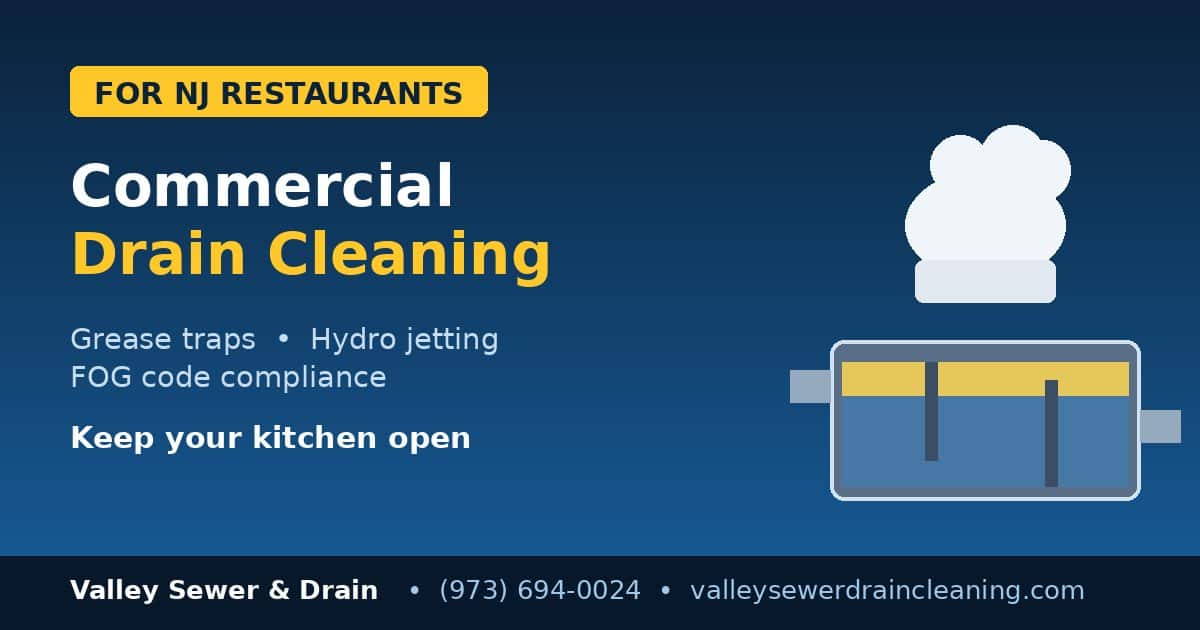
The grease trap (smaller, indoor, higher flow) or grease interceptor (larger, usually outdoor and underground) is the device that keeps your kitchen’s fats, oils, and grease out of the municipal sewer. Wastewater flows in, sits long enough for grease to cool and float to the top and solids to settle to the bottom, and the cleaner water in the middle continues to the sewer. It works — until it fills up. A neglected trap stops separating grease, sends FOG straight into your lines and the public sewer, and produces backups and foul odors that clear a dining room fast.
Grease traps are not optional in New Jersey. Under the widely adopted FDA Food Code and local plumbing and sewer-authority rules, food service establishments that discharge grease are required to install and maintain them — and to keep cleaning records available for inspection. The common industry benchmark is the “25% rule”: clean the trap before accumulated grease and solids reach a quarter of the trap’s total depth, which for most restaurants means cleaning on a regular monthly or quarterly cycle depending on volume.
Why Hydro Jetting Is the Commercial Standard
In a home, snaking handles most clogs. In a commercial kitchen, snaking a grease-caked line is like wiping a greasy pan with a dry paper towel — it bores a hole through the blockage but leaves the grease coating the walls, and it re-clogs within weeks. Hydro jetting is the commercial answer: high-pressure water scours the entire pipe interior back to bare pipe, removing grease, food debris, and scale completely. For a restaurant line, jetting on a schedule keeps the pipe at full capacity so it can handle service every night. (We break down the full comparison in our hydro jetting vs. snaking guide — for commercial grease lines, jetting wins nearly every time.)
FOG Compliance: What NJ Food Businesses Must Know
FOG — fats, oils, and grease — is the single biggest threat to sewer systems, and regulators treat it accordingly. The U.S. EPA identifies grease as a leading cause of the sanitary sewer overflows that municipalities work to prevent, and that’s why local sewer authorities across New Jersey enforce FOG programs on food businesses. Practically, compliance means:
- A properly sized, functioning grease trap or interceptor for your kitchen’s output
- Regular cleaning on a documented schedule — with records kept on-site for inspection
- Keeping FOG out of drains at the source through kitchen best practices
- Proper disposal of collected grease through a licensed hauler, not down any drain
Non-compliance carries real consequences: fines, surcharges, failed inspections, and liability if your grease contributes to a sewer overflow. A maintenance partner who documents every service keeps your paperwork inspection-ready as a matter of course.
What a Commercial Drain Maintenance Program Includes
- Scheduled hydro jetting of kitchen lines and the main — frequency matched to your volume (monthly, quarterly, or semi-annual)
- Grease trap/interceptor cleaning on a compliant schedule with documentation
- Floor drain and branch line service to keep the whole kitchen flowing
- Camera inspections to catch developing problems before they close you
- Priority emergency response for contract customers when something can’t wait
- Service records that satisfy FOG program and health-inspection requirements
The goal is simple: your drains never become the reason you can’t open. For pricing context on individual services, our NJ drain cleaning cost guide covers standard rates, though commercial programs are quoted per-kitchen based on volume and equipment.
Kitchen Best Practices That Reduce Buildup
Maintenance keeps lines clear; good kitchen habits slow how fast they fill between visits. Train staff on these and you’ll stretch every service interval:
- Scrape and dry-wipe all plates, pans, and cookware into the trash before they hit the dish pit
- Never pour grease or fryer oil down any drain — collect it for licensed pickup
- Use drain screens on every sink and floor drain to catch solids
- Collect and recycle used cooking oil through a rendering service
- Post FOG best-practice signage at sinks as a constant reminder for staff
- Don’t rely on hot water and soap to “melt grease away” — it just re-solidifies down the line
The Cost of Waiting vs. the Cost of a Program
Restaurant owners sometimes see a maintenance contract as an expense to trim. The math says otherwise. A single emergency backup during service can mean a closed kitchen for the night, spoiled prep, a health-code violation, an after-hours emergency bill, and — worst of all — customers who found somewhere else to eat. A scheduled maintenance program costs a predictable, budgetable fraction of that, and it turns drains from a business risk into a non-issue. For a food business, the question isn’t whether you can afford commercial drain maintenance; it’s whether you can afford the shutdown that skipping it eventually causes.
Beyond Restaurants: Other Commercial Kitchens We Serve
The same principles apply to any facility with a commercial kitchen or heavy drain load: catering operations, banquet halls, cafeterias, schools, senior-living facilities, bars and breweries, delis, bakeries, and food-processing sites. If your business generates grease or high-volume wastewater, it needs commercial-grade drain care — and likely falls under the same FOG requirements. We serve commercial clients across Essex, Morris, and Passaic counties; see our full service area here.
Frequently Asked Questions
How often should a restaurant’s grease trap be cleaned?
The common standard is the “25% rule” — clean before grease and solids reach a quarter of the trap’s depth. For most NJ restaurants that means monthly or quarterly, depending on volume. High-output kitchens may need more frequent service. Your local sewer authority may also set a required schedule.
Is a grease trap required for my NJ food business?
Almost certainly, yes. Food service establishments that discharge grease are required to have a properly sized, maintained grease trap or interceptor under the FDA Food Code and local sewer-authority rules. Even small operations — delis, coffee shops, bakeries — typically need one.
Why does my commercial kitchen keep getting drain backups?
Grease buildup is the usual cause. If lines are only being snaked, the grease coating the pipe walls stays behind and re-clogs quickly. Scheduled hydro jetting removes it completely and keeps lines at full capacity between services.
What happens if I don’t maintain FOG compliance?
Consequences can include fines, sewer surcharges, failed health and plumbing inspections, and liability if your grease contributes to a sewer overflow — plus the operational cost of the backups that non-maintenance causes.
How much does commercial drain cleaning cost in NJ?
Commercial work is quoted per kitchen based on volume, equipment, and service frequency rather than a flat residential rate. A scheduled program is priced to be predictable and is far cheaper than emergency shutdowns. Contact us for a walkthrough and quote.
Do you offer scheduled maintenance contracts?
Yes. Valley Sewer & Drain sets up recurring maintenance programs — jetting, grease trap service, inspections, and documented records — matched to your kitchen’s needs, with priority emergency response for contract clients.
Keep Your Kitchen Open. Put Your Drains on a Schedule.
Don’t wait for a backup during dinner service to think about your drains. Call Valley Sewer & Drain at (973) 694-0024 or request a quote online for a commercial drain cleaning and maintenance program built for your kitchen — hydro jetting, grease trap service, FOG-compliant documentation, and priority response across Essex, Morris, and Passaic counties.