
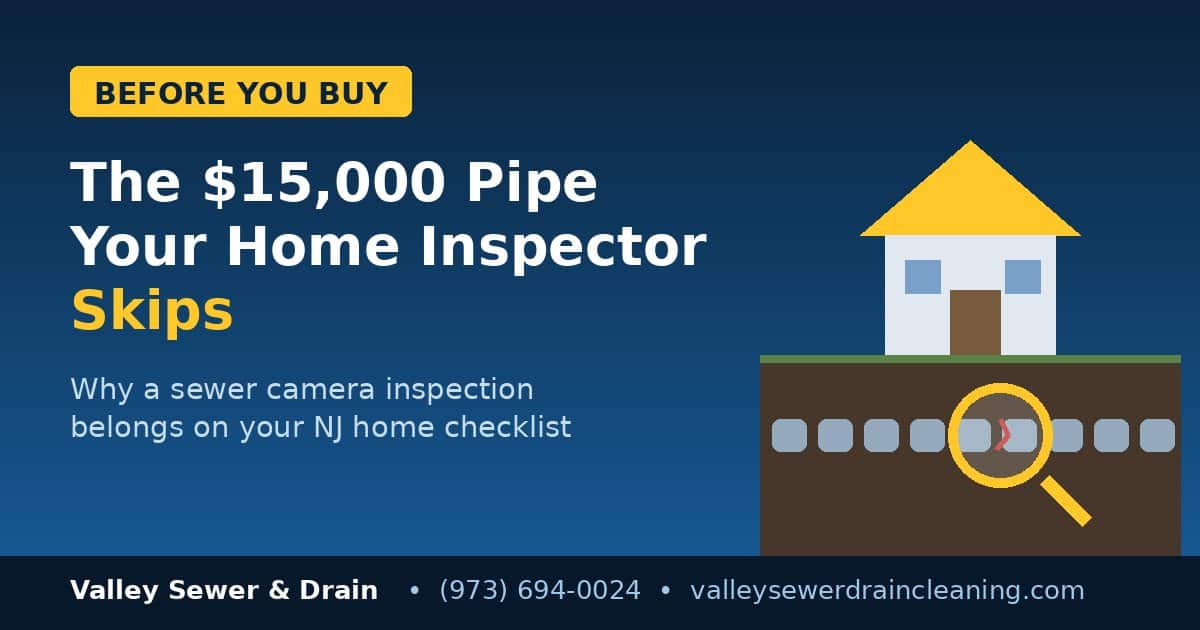
Your home inspector will check the roof, the furnace, the electrical panel, and the grout in the guest bathroom — and never once look at the single pipe that could cost you $20,000. The sewer lateral, the line carrying all wastewater from the house to the street, is excluded from virtually every standard home inspection. In Morris County, where a huge share of the housing stock predates 1980 and sits under mature trees, that blind spot is exactly where the expensive surprises hide. A pre-purchase sewer camera inspection costs a few hundred dollars and is the highest-leverage contingency most buyers never think to ask for. Here’s why it belongs on your checklist — and what it can save you.
Key Takeaways
- Standard home inspections do not include the sewer lateral — it’s a documented exclusion
- Sewer line replacement runs $8,000–$20,000+, and it’s the buyer’s problem the day after closing
- Morris County’s older homes + mature trees = high root-intrusion risk
- A pre-purchase scope ($250–$550) either clears the line or becomes a negotiating tool
- Valley Sewer & Drain does fast pre-closing inspections with footage you keep: (973) 694-0024
The Home Inspection Blind Spot Nobody Warns You About
A general home inspection is broad but shallow by design — the inspector visually assesses what’s accessible and reports on condition. The sewer lateral is neither accessible nor visual: it’s buried three to six feet underground, running from your foundation to the municipal main in the street. Home inspectors don’t have cameras threaded down cleanouts, and their standards of practice specifically exclude underground piping. So a house can pass its inspection with flying colors while a root-choked, cracked, or partially collapsed sewer line sits silently underground, waiting for your first Thanksgiving to announce itself.
The financial structure is what makes this dangerous. The moment you close, that lateral is 100% your responsibility — the seller is gone, the inspection is over, and a five-figure repair is entirely yours. A $300 camera inspection before closing is the only point in the entire transaction where that risk is still someone else’s to fix or discount.
Why Morris County Homes Are Especially at Risk
Two factors stack the deck in this part of New Jersey, and they compound each other:
- Age of the housing stock. Much of Morris and Essex County was built between the 1920s and 1970s, meaning original sewer laterals are often clay, cast iron, or — in some mid-century homes — Orangeburg, a wood-fiber pipe with essentially no service life left today. These materials crack, corrode, and deform with age.
- Mature trees everywhere. The same established, tree-lined charm that draws buyers to towns like Morristown, Denville, Mountain Lakes, and Chester means decades-old root systems reaching straight for the moisture leaking from aging pipe joints. Root intrusion is the #1 cause of sewer failure in exactly these neighborhoods (our full guide: tree roots in your sewer line).
Put an old clay lateral under a 70-year-old oak and you have the textbook setup for root intrusion and pipe failure — often with zero symptoms during the brief window a house is on the market and lightly occupied.
What a Pre-Purchase Sewer Inspection Reveals
A sewer camera inspection runs an HD camera the full length of the lateral and shows exactly what you’re buying underground:
- Tree roots — present or not, and how severe
- Pipe material and condition — including whether it’s problem-prone Orangeburg or corroded cast iron
- Cracks, breaks, and collapsed sections — the five-figure findings
- Bellies (sags) that will clog repeatedly for as long as you own the home
- Offset or separated joints leaking sewage into the soil
- Existing or past repairs — and whether they were done properly
You watch the footage with the technician and keep the recording. Everything about the pipe’s future — routine maintenance, a manageable cleaning, or a looming replacement — comes into focus before you’ve signed anything. (For the full walkthrough of how the scope works, see our sewer camera inspection guide.)
The Math: A $300 Inspection vs. a $15,000 Surprise
This is the easiest cost-benefit calculation in home buying. A pre-purchase sewer scope runs $250–$550. The repairs it can uncover:
| Finding | Typical NJ Repair Cost |
|---|---|
| Root cleaning / hydro jetting | $400 – $950 |
| Spot repair (one damaged section) | $2,000 – $6,000 |
| Full lateral replacement | $8,000 – $20,000+ |
If the line is clean, you’ve bought certainty and a baseline recording for a few hundred dollars — cheap peace of mind. If it’s not, you’ve just found a problem while you still have leverage: the power to ask the seller to repair it, credit you for it, or adjust the price. Discovered the day after closing, that same problem is a bill with your name on it and no one to send it to. (Full repair-side pricing is in our sewer line excavation guide and drain cleaning cost guide.)
How to Add a Sewer Inspection to Your Home Purchase
- Schedule it during your inspection contingency period — the same window as your general home inspection, so any findings feed directly into negotiations.
- Order it independently. Bring in a dedicated sewer company rather than assuming the home inspector covers it (they don’t). Ask for it explicitly.
- Ask your agent to add sewer results to the negotiation. Documented pipe problems are legitimate grounds to request repairs or a credit — sellers deal with them routinely.
- Keep the footage. Even on a clean line, the recording is your baseline for future maintenance and a selling point when you eventually list the home.
- Move quickly. Reputable companies can usually inspect within a day or two — well inside a normal contingency window.
Already Bought Without One? It’s Still Worth Doing
If you’ve recently closed on an older home and skipped the sewer scope, don’t wait for a backup to find out what’s underground. An inspection now establishes your line’s condition, catches root intrusion or early damage while it’s still a cleaning instead of a replacement, and lets you plan any work on your schedule rather than during an emergency. It’s the same logic as the pre-purchase scope, just shifted a few weeks later — and still far cheaper than a sewage backup on a holiday weekend. We inspect for new homeowners throughout the area, from Randolph and Parsippany to Rockaway and beyond.
Don’t Take Our Word for It — It’s in the Inspection Standards
This isn’t a sales angle; it’s written into the profession’s own rulebook. The widely used home inspection standards of practice from the International Association of Certified Home Inspectors (InterNACHI) define a general home inspection as a non-invasive, visual examination of the accessible areas of a property — and then explicitly list what the inspector is not required to do, including inspecting underground utilities and underground items. A buried sewer lateral is, by definition, both underground and not visually accessible. A conscientious home inspector will flush toilets and run the sinks to confirm water goes down, but that tells you nothing about the condition of the pipe carrying it to the street. Confirming the lateral itself requires a separate camera scope — which is exactly why a dedicated sewer inspection exists as its own service.
Frequently Asked Questions
Does a standard home inspection include the sewer line?
No. General home inspections specifically exclude underground and buried piping, including the sewer lateral. A camera inspection by a dedicated sewer company is a separate service you have to request.
How much does a pre-purchase sewer inspection cost in NJ?
Typically $250–$550 in New Jersey. Against potential repairs of $8,000–$20,000+ for a failed lateral, it’s one of the highest-value inspections a homebuyer can order.
Should I get a sewer inspection on a newer home?
The risk is highest on homes built before 1980, but even newer homes can have bellied pipe from settling, construction debris, or root intrusion. If the home has mature trees or any history of drainage issues, a scope is worth it regardless of age.
Who pays for sewer repairs found before closing?
That’s negotiable — which is the whole point of inspecting before you close. Documented problems give you standing to request that the seller repair the line, credit you the cost, or reduce the price. After closing, repairs are entirely the buyer’s responsibility.
Can a sewer inspection kill my home purchase?
Rarely — most findings are negotiable, not deal-enders. And knowing about a serious problem before closing is always better than owning it afterward. Information protects you; it doesn’t trap you.
How fast can a sewer inspection be scheduled during closing?
Usually within a day or two, comfortably inside a standard inspection contingency period. Let the company know you’re on a closing timeline and they’ll prioritize it.
Closing on an Older NJ Home? Scope the Sewer First.
Don’t let the one pipe your home inspector skips become your first big expense as a homeowner. Call Valley Sewer & Drain at (973) 694-0024 or request a free estimate online for a fast, pre-closing sewer camera inspection with footage you keep — across Morris, Essex, and Passaic counties. See our full service area here.